


Accessories and Consumables
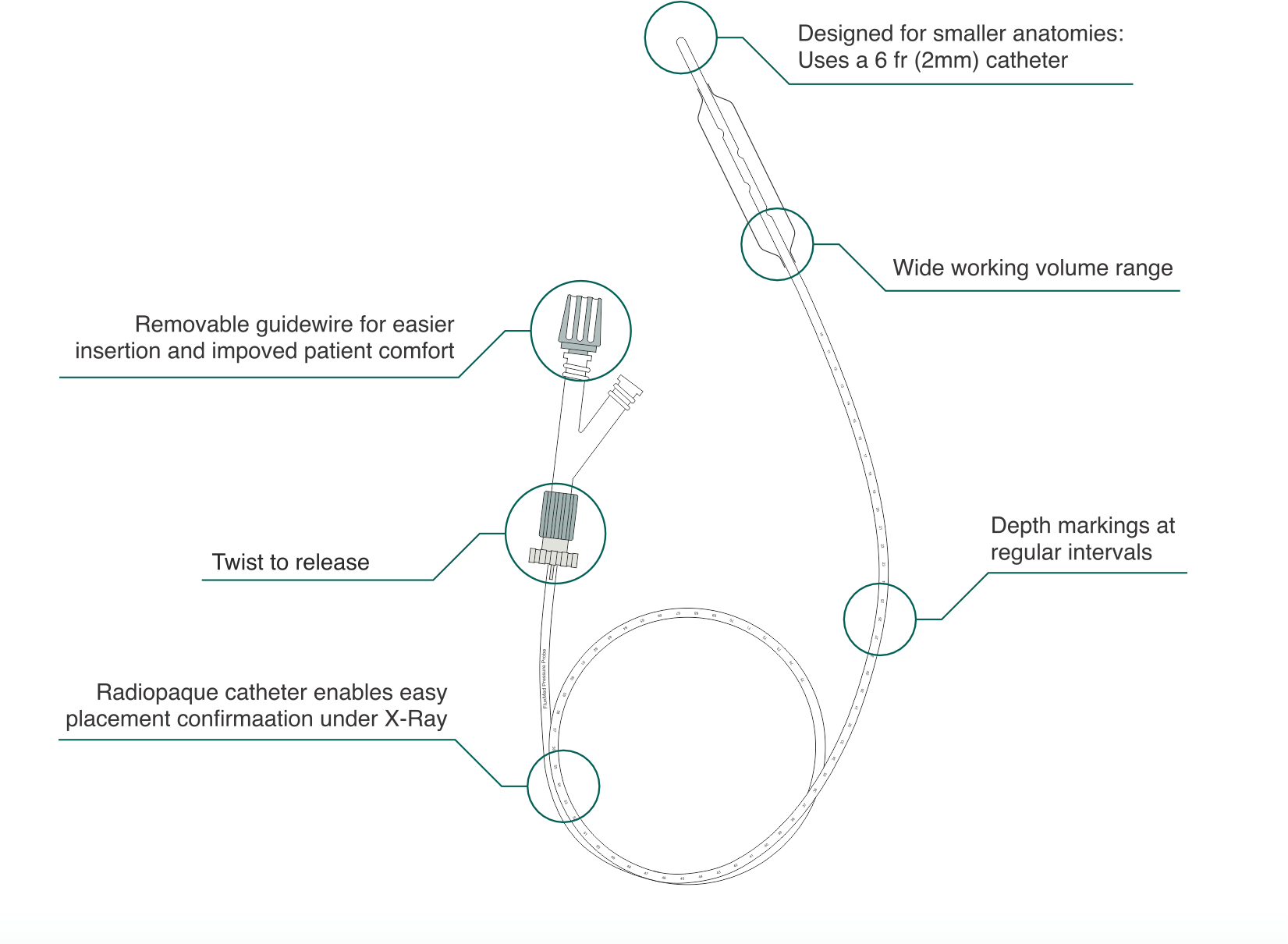
The FluxMed BA-P-006 (latex-free) probe can measure esophageal pressure, which is used to estimate pleural pressure during respiratory monitoring. This parameter is used to discriminate breathing impact on the chest wall and lung. It is worth noting that the accuracy of estimated pleural pressure based on esophageal pressure monitoring depends on the proper positioning of the catheter during clinical practice, and also on the properties of the catheter itself.
FluxMed pressure probes have outstanding technical properties, while being very easy to use. It is important that measurement tools does not change the value which is being measured. The FluxMed pressure probe has been designed under that understanding.
Technical Characteristics
- Static Response
For a manometry probe, static response is the ability to transmit the surrounding constant pressure at different filling volumes.
The probe was placed in a chamber that is pressurized at different pressure levels and the balloon was inflated at different filling volumes replicating the work previously published by Mojoli et al. on other probes with different mechanical characteristics [1].
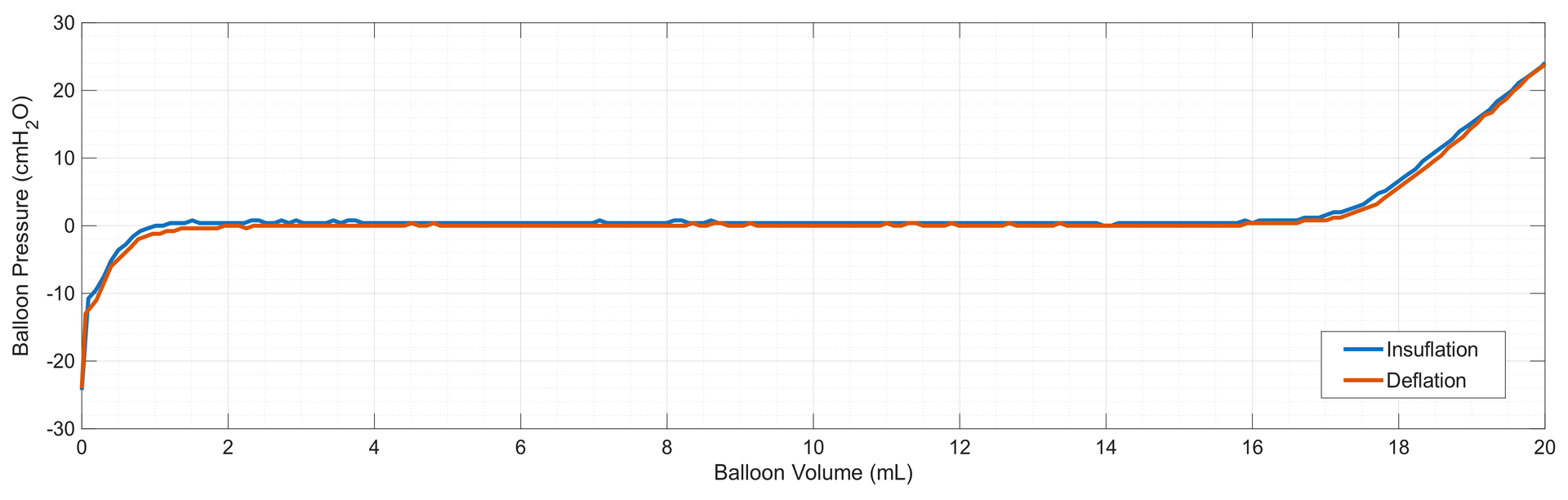
The measurement of the balloon has a great accuracy in all levels of pressurization with filling volumes between 1ml and 16ml.
Insufflation and deflation curves overlap, which shows that inflating and deflating the balloon results in the same pressure. The balloon has no hysteresis.
- Dynamic Response
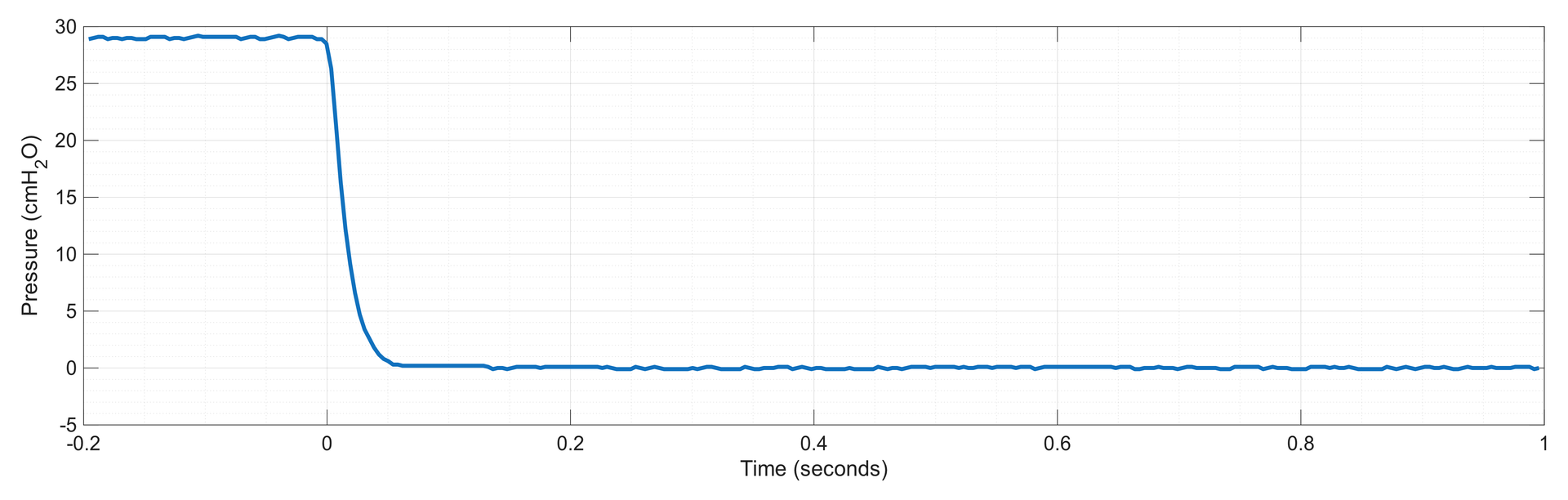
For a manometry probe, the dynamic response is the ability to measure changes in surrounding pressure.
The probe was placed in a pressurized container and fast depressurization of the container was performed taking pressure abruptly to 0 cmH2O. The experiment was performed, replicating the methodology described by Cross et al [2]. FluxMed BA-P-006 has a very fast response according to what is needed to assess respiratory physiology.
References:
[1] F. Mojoli et al. , “Esophageal pressure measurements under different conditions of intrathoracic pressure. An in vitro study of second generation balloon catheters.,” Minerva Anestesiol. , vol. 81, no. 8, pp. 855–64, Aug. 2015.
[2] T. J. Cross, S. Lalande, R. E. Hyatt, and B. D. Johnson, “Response characteristics of esophageal balloon catheters handmade using latex and nonlatex materials.,” Physiol. Rep. , vol. 3, no. 6, p. e12426, Jun. 2015.